Monday, 7 July 2025

Time-Travel Through Pictures

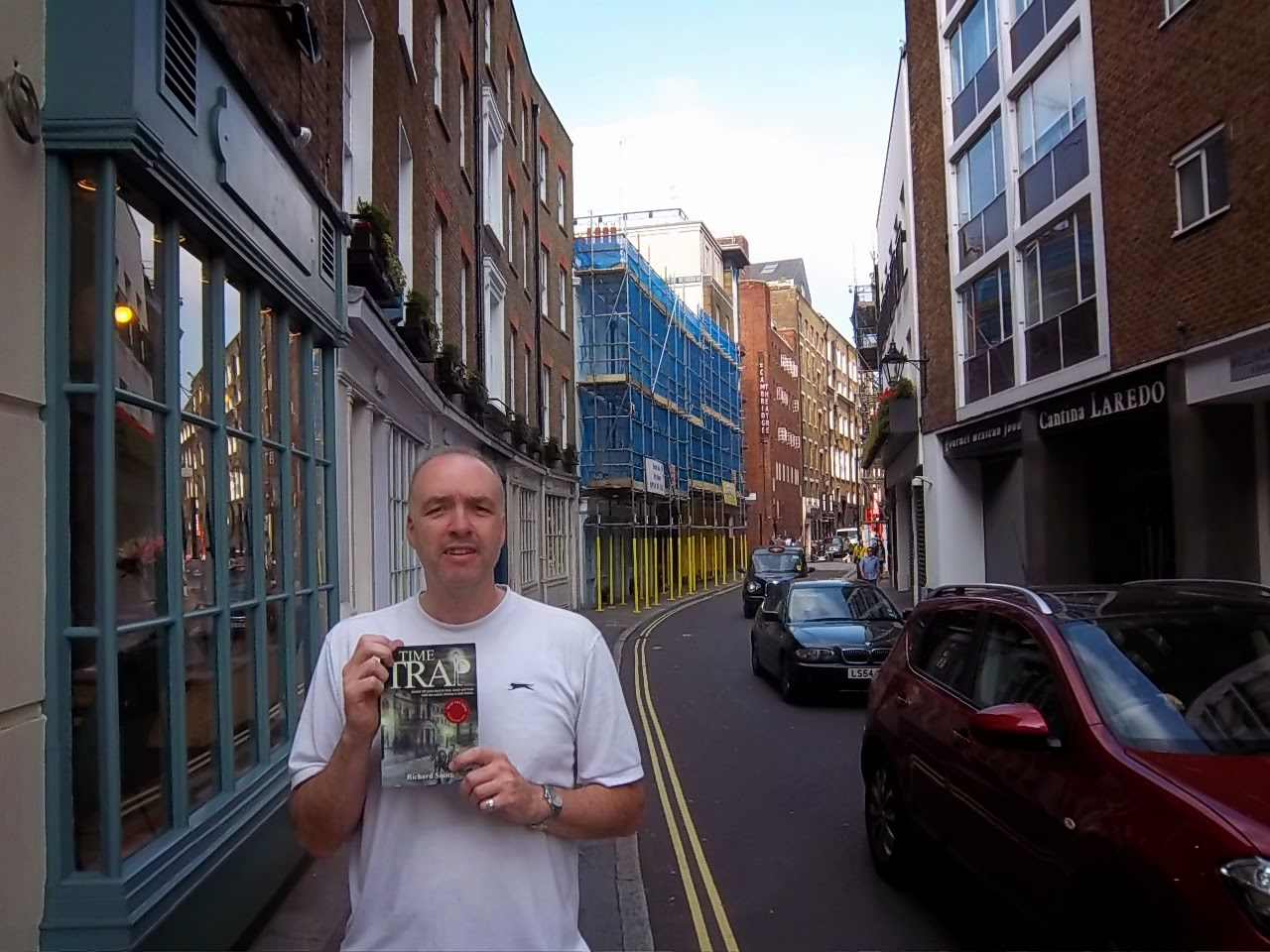
 Shelton Street (a tad from the Time Trap Trail, close to Seven Dials)


William Shelton was a holy man and a philanthropist who stipulated in his will that the poor of St Giles should be clothed and educated by his estate. From Shelton’s death in 1661, until 1763, a free school was established in nearby Parker Street which taught 50 local ragamuffins (usually, a child in rags) in English, humanities, classics and good manners, he also left a legacy to provide “the habit of a gentleman” to 20 beggars each year. Given that even the wealthier rookery-dwellers would go around in rags; these 20 must have been the best-dressed vagrants in history!

Until 1877, Shelton Street was known as Castle Street and it marked the unofficial south-eastern fringe of the sprawling St Giles rookery. This area inspired many of Dickens’s depictions of Victorian London’s seedy underbelly. Today, the narrow street, stretching from Drury Lane to St Martin’s Lane still gives clues to its iniquitous past with a number of alleys and courtyards where footpads and highwaymen would have skulked menacingly in the shadows, waiting for the next wealthy merchant to plunder.


Through the fog, Jamie glimpsed small children still out playing, despite the freezing weather. They would appear and then fade into the fog, hopping and skipping along. One group played a game where they rolled head-over-heels.
Jamie and Todd moved through a sea of paupers. Faces peered from everywhere; entire families gathered in the street. Outside one house, a goat stood chained to railings and chickens clucked in small cages. Outside another, Jamie stared up at a large woman barely visible, leaning from an upstairs window, tending to freshly laundered clothes. She hung a sheet over a protruding wooden pole to dry, though it was already grimy from the sooty fog. Jamie soon realised there were many poles along the street with washing fastened and likened them to masses of flags.

Time Trap

Charles Dickens’s son, Charles Dickens Junior describes it thus:

“Here poverty is to be seen in its most painful features. The shops sell nothing but second or third hand articles. 
The street swarms with children of all ages… Public houses abound and it is evident that whatever there may be a lack of, there is no lack of money for drink.”


Shelton Street today.


Wednesday, 9 April 2025

Historic backdrop to Time Trap II


American history has always fascinated me, so it was a pleasure to do the research for Time Trap II. The War of Independence and the American spy network - the Culper Spy Ring - to name but two. The spies did so much essential work for the war effort and then there was the mysterious Agent 355 whose identity has never been revealed. The spy ring and the unknown agent feature in TT II. 

Here is a brief telling of the background to the story when Jamie, Todd, Catherine and Hector go back in time to the 18th century to prevent a gun from the future being used at the Battle of Bunker Hill.

By 1775, a large number of so-called colonists – many of them British, with others from different European countries -had settled in the area we now call New England, in the north-east of the country we now call America.

Their colonies were called Massachusetts, Virginia, Rhode Island, Maine, New Hampshire and Vermont. (Each is now one of the states of the U.S.A) Eventually, the British had 13 English colonies, which were administered by governors appointed by the King of England, George III. That fact, and dissatisfaction with the taxes (payable to the British Government, which in no way represented the colonies or colonists living in them) and also with regulations concerning restrictions upon trading – all designed to benefit Britain, rather than its 13 colonists – eventually led to the American War of Independence, which lasted from 1775 until 1783, and ended in victory for America, who defeated the British. In 1789, all the colonies united under USA’s first president, George Washington, and gained their freedom from foreign control.

You should also know that there was, in the American War of Independence, a Battle of Bunker Hill – which is near Boston. It was the first sizeable battle of the war, and although a victory for the British, more than 1,000 of them were killed or injured in the battle, compared with only 420 Americans.

As well, there really was a Gatling gun (invented in 1861) named after the man who invented it: Richard Gatling. He was an American from North Carolina. He studied medicine before becoming an inventor. Gatling wanted to create a devastating weapon that would reduce the size of armies and so reduce the number of deaths. (But it didn't quite work out that way, unfortunately) His gun had many barrels, and was capable of firing 250 rounds in just one minute!


However, that is historical fact, if the gun is used in battle, the world's future will be ruined irreparably...


Image result for gatling gun


“It occurred to me that if I could invent a machine - a gun - which could by its rapidity of fire, enable one man to do as much battle duty as a hundred, that it would, to a large extent supersede the necessity of large armies, and consequently, exposure to battle and disease would be greatly diminished.”


Richard Jordan Gatling

Monday, 12 June 2023

Buy Time Trap now

Here are extracts from Catherine's memoirs, one of Time Trap's most popular characters. She tells how difficult it was for women to venture into science in the 1800's. She also mentions Hector Lightfoot, the inventor of the time-travelling device, and Jamie and Todd, who turned up unexpectedly, (from the 21st Century) when an extraordinary adventure took place.



Catherine was born in 1827 to upper-middle class Scottish parents. When she was three, the family moved from Edinburgh to Kensington, London. From around that time, she could remember the house in London being busy a lot of the time.

My early childhood memories of my father were at our house, where serious-looking men in top hats and long-tailed coats would often join him to talk and drink gin. Little did I know, back then, they were scientists, like my father - although he was the most eminent of them all, and made vital discoveries in medicine. Apart from when he held these big gatherings, I almost never saw him, as he was working all hours at the laboratory.

Taken from Catherine’s memoirs - 1898

Her father sent her to a strict school for girls, in Buckinghamshire, which had a high success rate. It was the harsh regime there which gave Catherine her steely willpower and drive.

When I first arrived at the school, I was devastated that my father had chosen to send me there. As well as being taught by austere and distant teachers, I was bullied by a small clique of girls, who taunted me for being Scottish. It was hell for the first 12 months, but the day came when I put an end to the torment: I took on the ring-leader and beat her. I gained their respect and from then on, I was able to study without distraction.

Catherine excelled in her second year, achieving top marks in all subjects. She continued to achieve a high standard throughout her school career, which enabled her to make a choice from all the sciences: she selected Astronomy.

I was torn between Astronomy and Chemistry. I loved them both. My father wanted me to opt for Chemistry, but the stars won the day. I wanted to follow in the footsteps of the great astronomers, Newton, Halley and William and Caroline Herschel. 

Making her way in the scientific world in the 19th Century proved difficult; women were hardly represented in any professional field, and were actually discouraged from pursuing a career. Caroline Herschel learned astronomy as an assistant to her brother William. Only when William was away from home did Caroline have much opportunity to use the telescopes that they and another brother had built together. In 1783, she discovered fourteen nebulae, and between 1786 and 1797, she discovered eight comets - proving that women were just as competent as men.

Caroline Herschel and Mary Fairfax Somerville were such inspirations to me. I was fortunate to meet Mary, a fellow Scot, on a number of occasions. I eventually made it into Astronomy without my father’s influence - something which I am very proud of (as was he) - although he was there with his connections if I had failed. 

The number of women scientists working with their husbands grew in the 19th Century. Notable examples are Mary Lyell, a conchologist; Marie Pasteur, a biologist; Mary Buckland, a geologist and the astronomer Margaret Huggins. Yet, despite all their accomplishments, it was a commonly-held belief that developing a woman's intellectual capacity would always diminish her reproductive capacity.

Venturing into science in the mid-1800’s was very difficult for a woman, without a prominent, well-connected man’s help. My father was friends with the engineer, Hector Lightfoot, and in 1849, he introduced us. I was 22 and Hector was 15 years older - and was a dashing, former, army captain. He introduced me to the Science Council at the Science Institute in Golden Lane, and I was accepted. It was the breakthrough that I needed.


An 18th Century "Gregorian" Reflecting table telescope

Catherine quickly established herself at the Science Institute, with her discovery of nebulae, and was one of the first to suggest that stars were suns - which was confirmed in 1861 by William and Margaret Huggins. Almost her entire life revolved around her work, leaving no time for anything else.

I loved my work, and with every success I was helping other women in their struggles to lead a life in science. In 1851, I accompanied Hector to the Great Exhibition, where some of his work was featured. He had made huge in-roads in engineering - a remarkable achievement, as he’d served in the army until he was 33. It was while we were at the Great Exhibition that he went down one knee and proposed. He had, of course, asked my father’s permission first, and been given it, but I declined - although I knew it hurt him. He left for China soon after, on a secret mission.

The following year, Catherine’s life came crashing down when her father died of Cholera.

The Summer of 1852 was the worst time of my life. My father contracted cholera in July and died the following month. I still regret to this day that I didn’t spend more time with him after working at the Institute. Unfortunately, nothing else mattered to me, I was deeply involved with my work, and every time he suggested we meet, I told him I was too busy. It hurts to admit it, but I neglected my father. And as the months wore on, I began to miss Hector more and more.

From 1852 to 1856, Catherine continued her important work, and carried on making vital discoveries. In 1855, she was awarded into the Fellows of the Royal Society: she had well and truly made her mark. In 1856, Hector Lightfoot returned from China with an extraordinary proposition.

In the Spring of 1856, Hector appeared out of the blue. How pleased I was to see him. He told me of his amazing adventures in China, and wanted my help with an astonishing project, backed by the Science Council. For the next five years, he and I worked closely - non-stop - on the secret project - with which - although it went against my ethics, I proceeded, because of Hector’s noble intentions. After five years, the project - which even now, 37 years later, remains a secret - was finished. We had achieved our aim.

The diligent work which Catherine and Hector Lightfoot together undertook in a laboratory under the British Museum, stopped after five years when, in December, 1861, Hector went missing under suspicious circumstances.

I can’t say too much about this time, as I’m sworn to secrecy, but I can say, that one year after Hector’s disappearance, two boys, Jamie and Todd came into my life, and we were involved in a tremendous adventure, culminating in me reuniting with Hector. The boys were not around for long, but they had an everlasting effect on Hector and on me. I said yes to Hector’s second marriage proposal and we got married in 1863. If I was to be honest, I loved Hector soon after we met, but my work was so important to me that I couldn’t allow distractions.

Now, at the age of 71, I continue my work in Astronomy, and am every bit fascinated with it today as I was when I began. With the new century almost upon us and Hector  still reasonably active at 86, we are both optimistic for the future, and know that, one day, man will reach and walk on the moon. 


"A woman's place is in the dome" Mary Lou West

Thursday, 5 August 2021

Book signing

Had a very successful book signing event where I work. Some wine consumed, a good turn out and 30 books sold.


Tuesday, 19 November 2019

Time Trap II is now out, but here’s something about the first book – Time Trap.


                           Sequel to Time Trap 


                      The book with a London walk connected to the story


Once you’ve read Time Trap, you can bring the story to life, by following the Time Trap Trail. The Trail is a self-guided walk, which features London locations in the book. You’ll get to see parts of the capital, few might know, and it may enhance your knowledge of getting around the city. Working on the Trail certainly gave me a better understanding with the layout of London. (I recommend you go with an adult to be on the safe side, but make sure they’ve read it too, as I explain the locations related to the story) 


By following in Jamie’s and Todd’s footsteps, you’ll get to see the British Museum, the Holton gang’s hideout, which was in the vicinity of Seven Dials, an area once associated with crime and poverty, the magnificent St Paul’s Cathedral and other places of interest. 


Take a look at the Certificate, which I will email you with your name and the date you completed the Trail - for you to print off – once you email me the answers to the observational questions on the Trail


Happy reading and sight-seeing!


Thursday, 16 May 2019

TIME TRAP II

The sequel to Time Trap 


Jamie and Todd are horrified to learn that the Grand Plan, which they thought had been defeated, is about to be implemented in 1775, America. Hector and Catherine have to go back in time and thwart Travis - an agent of the Grand Plan - who is hell bent on world domination. 

Jamie and Todd go with Hector and Catherine on a mission to 1775, to prevent a super gun from being used in the Battle of Bunker Hill, during the American War of Independence, but only have days to stop history from being altered.


Tuesday, 11 September 2018

The Time Trap Trails


Imagine reading a book, then visiting the very places where the story happened; it would almost be like going on a virtual-reality tour. With Time Trap, you can do just that, and see the London locations where this exciting adventure is set.

The Trails are an adventure, too: follow in Jamie's and Todd's footsteps as they were hurled back to 1862, when the streets of London were shrouded with smog, and danger lurked at every turn.

By following the Time Trap Trails, you will see a very different London - one that few may know. You'll visit the scenes of all the crimes that Jamie and Todd were involved in when they had to join the Holton Gang, and see where the gang's hideout was. You'll get to see magnificent St Paul's Cathedral - and many, many more locations featured in the book. Plus, there's an added guide to other attractions along the way.

 Also, by going on the Trails, it will give you a good sense of the layout of London; it did me, when I worked on them. 

Check them out here


Friday, 26 May 2017

THE DARZIODS' STONE


What DID the Knights Templar unearth beneath Temple Mount? Five school friends find out to their cost when they discover a secret code in a cursed Cornwall cove

A SPECIAL STONE HIDDEN IN A QUIET COVE IN CORNWALL MORE THAN 200 YEARS AGO, IS THE OBJECT OF A DESPERATE SEARCH BY TWO OPPOSING FACTIONS.

WHEN HARRY AND HIS SCHOOLFRIENDS DISCOVER A CODE WHILST HOLIDAYING IN THE COVE, THEY ASSUME IT WILL LEAD THEM TO HIDDEN TREASURE.

BUT AN EVIL ORDER, WITH SEEMINGLY SUPERNATRURAL POWERS, ARE WORKING AGAINST THEM. THE TEENAGERS SOON FIND THEMSELVES CAUGHT UP IN A DEADLY BATTLE, AND WILL BE LUCKY TO ESCAPE WITH THEIR LIVES, LET ALONE GET THEIR HANDS ON THE TREASURE.


BEST REVIEW YET!


The Darziods’ Stone by Richard Smith is a riveting tale that takes readers on a fast-paced, thrilling adventure that leads to unexpected discoveries.

Wow! From the first page to the last, this book had me on the edge of my seat a great deal of the time. This novel was very impressive and completely blew my mind! It more than met my expectations, if anything it exceeded them. I would be up at odd hours of the night reading the book, and when I finally went to bed: my mind stayed awake, riddled with thoughts over something that had happened as a result of plot twists that I had not anticipated.
The author also did a remarkable job of melding fact and fiction: which not only made for a believable narrative but one that was very insightful and interesting as well.

I appreciated the well-written exposition and smooth transition from current events to past events. The authors writing style and formatting of the book ensured that there would be no confusion. I loved the element of surprise ushered by the plot twists in the book, I also totally did not expect the ending. There were moments when I was puzzled, intrigued, excited and at times saddened by what had transpired. I especially enjoyed the sense of humour brought to life by the cheeky dialogue that inspired quite a few laugh-out-loud moments.

After reading The Darziods’ Stone, I was in complete awe of the writer's ability to articulate and express his ideas in a fashion that transported the reader into the character’s world. The vivid and clear description of events and locations in the book worked well. On top of that, the drawings and illustrations featured: complemented the description of certain scenes and experiences—which is something I think younger readers will appreciate. Therefore, I am pleased to rate this book 4 out of 4 stars. I loved this book so much that I decided to purchase a copy for my younger brother. I recommend this book to young adults and anyone who loves a good mystery and adventure with a touch of history and sci-fi.


Ritah - onlinebookclub.com


Related image


THE DARZIODS'S STONE IS NOW AVAILBALE AS AN EBOOK, YOU CAN GET YOUR COPY HERE


Wednesday, 10 June 2015

Time-travel through pictures

This location is not to be found on the Time Trap Trail, (obviously) but the place is featured in the book, and has an interesting history.


Afghanistan


Sketch of the Bolan Pass, taken from Time Trap

10th March 1839

The invasion of Afghanistan begins. Under the command of Lieutenant-General John Keane, we head for Kandahar through the Bolan Pass, a huge chasm, running between preciptitous rocks for 70 miles. The invasion force stretches for miles, a vast, unwieldy column of soldiers, beasts and wagons.

24th November 1841

We counter-attack and retrieve the gun. I was knocked down by a blow on the head from an Afghan knife, which would have done for me had I not put a few pages of Blackwood’s Magazine in my forage cap. I could feel the blood running down my back as I got up, half-stunned. Seeing that a second blow was coming, I met it with the edge of my sword and removed my assailant’s hand. He bolted, but another slashed my shoulder with his sword. As my sword met his following strike, he was shot by an officer. I, too, was fired at; the shot hit my sword, breaking it in two, leaving six inches or so on the handle. I see Hector take a bullet in the lower back and go to his side as the men disperse and retreat. I pray Hector will live when we make it back to the cantonment.

Colonel Ramsbottom's journal - Time Trap


Image result for pictures of bolan pass afghanistan


The Bolan Pass today

The history of Afghanistan is a troubled and turbulent one, but also a fascinating one, which has seen much conflict over the centuries, from within, by its numerous tribal factions, and by foreign invaders, going back as far as 3000 BC. It's been used as a battleground for strategic wars by larger external powers, due to its geographic position between the Middle East, Central and South Asia.

I'm not going to write about every era of conflict, as there are so many, but provide a flavour.

Afghanistan became part of the Achaemenid Empire (550 - 330 BC) after it was conquered by Darius I of Persia. The area was divided into several provinces called Satrapies, which were ruled by a governor, or Satrap.

Alexandra the Great arrived in the area of Afghanistan in 330 BC. His army faced very strong resistance in the Afghan tribal areas where he is to have commented that Afghanistan is "easy to march into, hard to march out of." How many generals have repeated that, since?

An Islamic influence came when Rashidun Arabs conquered most of west Asia in 642 CE. They introduced the religion of Islam as they entered new cities. The early Arab forces did not fully explore Afghanistan due to attacks by mountain tribes.

From the 16th to the 17th century CE, Afghanistan was divided into three areas. The north was ruled by the Khanate of Bukhara, the west was under the rule of the Iranian Shia Safavids, and the eastern section was under the Sunni Mughats of northern India.

British influence began in the 19th century when the Russian Empire became a threat to West Asia and British India. This stand-off with Russia became known as "The Great Game."

The first Anglo-Afghan War, (1837-1842) which Hector Lightfoot from Time Trap, served as a captain, resulted in the defeat of the British Army; it is remembered by first-hand account as an example of the ferocity of Afghan resistance to foreign rule. The Second Anglo-Afghan War (1878 - 1880) was sparked by Shir Ali's refusal to accept a British mission in Kabul. This conflict brought Amir Abdor Rahman to the Afghan throne. It was during his reign (1880-1901) the British and Russians officially established the boundaries of which would become modern Afghanistan.

The Russians feature in Afghan history again, when the Saur Revolution overthrew the existing government in 1978 and implemented a Socialist agenda. Led by Hafizullah Amin and the military of the Khalq party, the agenda included a move to state atheism and introduced land reforms. The Mujadedeen loosely-aligned opposition forces, made up of groups of mostly Pashtun tribesmen, began attacks aimed at overthrowing the Marxist-Leninist government. The ruling party in turn requested the support of the Soviet Union in fighting the Mujahedeen. In December 1979, a massive initial deployment of 100,000 Red Army troops went into Afghanistan. The US saw this as a prime opportunity to weaken the Soviet Union as part of its Cold War strategy, and they began to provide training and arms to the Mujahedeen resistance groups, along with extra support from other countries such as Saudi Arabia and the UK. In 1989, the Soviet Union left Afghanistan, (leaving the Taliban to eventually take over the country) adding to the many other defeated armies to have invaded there.

So, with all this evidence of armies failing to defeat the Afghan tribesmen throughout history and a lot more I haven't mentioned, in 2001, George W Bush went into Afghanistan, known as: Operation Enduring Freedom (without an exit plan) with Tony Blair providing military support, where a long and bloody campaign ensued. To my mind, the conflict didn't achieve anything, and the tribal groups are still in force. The allied occupation ended in 2014.


Taliban fighters.


Thursday, 23 April 2015

Time-travel through pictures

Temple Bar - the Time Trap Trail


Sketch taken from Time Trap

The monument in the centre of the road, is where Temple Bar stood, which you will see later on the Trail. Temple Bar is a boundary marker, separating the City of London and Westminster. It was along this street, Hector drove his faltering contraption. 

Extract from the Trail

Catherine clasped her head, as Jamie opened the carriage door. He was reaching for the handrails and using the seat to hoist himself up. 'What are you doing, Jamie? Get back inside!' she screamed.
Jamie ignored her and hauled himself up the side-panelling. Temple Bar lay ahead. The ancient white gateway almost glowed in the moonlight. The driverless coach rapidly approached it. 

Time Trap


The history of Temple Bar is a fascinating one. It was erected as a barrier to regulate trade into the city. As the most important entrance to London from Westminster, it has long been the custom that the monarch stop at Temple Bar before entering the City of London, so that the Lord Mayor may offer him or her the City's pearl-encrusted Sword of State as a token of loyalty. 

Its name comes from the Temple Church, which has given its name to a wider area south of Fleet Street, the Temple, once belonging to the Knights Templar, but now home to two of the legal profession's Inns of Court.

Due to the ever increasing volume of traffic, the City of London Corporation were eager to widen the road, though unwilling to destroy so historic a monument, but in 1878, Temple Bar was dismantled carefully (2,700 stones) piece-by-piece over an 11-day period. In 1880, it ended up being erected as a gateway at the house of the brewer Henry Meux, in Theobalds Park.

There it remained, incongruously sitting in a clearing in a wood, from 1878–2003. But where is it now? If you follow the Time Trap Trail, you will get to see it in all its glory.


The structure that replaced Temple Bar. With the removal of Wren's gate, it was designed by Horace Jones, as a memorial to mark Temple Bar, which was unveiled in 1880.


ONCE YOU COMPLETE THE TRAIL AND EMAIL ME THE CORRECT ANSWERS, I WILL DOWNLOAD TO YOU THE PERSONALIZED CERTIFICATE!


Can you see Temple Bar on the map?


Tuesday, 14 April 2015

Time-travel through pictures

Here's another location on the Time Trap Trail


Farringdon Road


Sketch taken from Time Trap

Turn right and stop at the first set of traffic lights. From where you stand, look to the right, and there was the construction site of the Metropolitan Railway. Jamie and Todd climbed down the ladder escaping Billy and his gang, and sprinted into the tunnel. They emerged further up Farringdon Road, only to fall into the hands of Billy and the others.

Extract from the Trail


Knowing its history and development, Farringdon is one of my favorite places in London. Back in the 1860's, the area was awash with Victorian rebuild and innovation. Above, is a sketch of the Metropolitan Line under construction. Opened in !863, with gas-lit wooden carriages hauled by steam locomotives, it was the world's first underground railway.
The "cut and cover" method was a simple way of construction for shallow tunnels, where a trench was excavated and roofed over with an overhead support system strong enough to carry the load of what was to be built above the tunnel. Many houses and buildings were demolished during the works, from Farringdon to Paddington.


  Todd read aloud from a large billboard: ‘Metropolitan Railway.’
  ‘Haven’t you heard of the new form of transport?’ Mr Wiggles asked. ‘Trains that go under the ground? Sounds daft to me; only the sewers should go underground. Can’t see it catching on.’
  ‘It’s the start of the London Underground,’ said Jamie, softly. ‘The Victorians were so clever.’
  ‘I’d never have guessed it went this far back in time,’ Todd whispered. He asked Mr Wiggles if they could take a closer look.
  ‘Oi!’ a juvenile voice shouted.
  Jamie’s stomach sank; the gang they had encountered earlier were spread out along the road behind them.

Time Trap


Farringdon Road today, where the Metropolitan Line runs beneath.

ONCE YOU COMPLETE THE TRAIL AND EMAIL ME THE CORRECT ANSWERS, I WILL DOWNLOAD TO YOU THE PERSONALIZED CERTIFICATE!


Can you spot the Metropolitan Railway under construction, on the map?


Tuesday, 24 February 2015

Time-travel through pictures

Shelton Street (a tad from the Time Trap Trail, close to Seven Dials)


William Shelton was a holy man and a philanthropist who stipulated in his will that the poor of St Giles should be clothed and educated by his estate. From Shelton’s death in 1661, until 1763, a free school was established in nearby Parker Street which taught 50 local ragamuffins (usually, a child in rags) in English, humanities, classics and good manners, he also left a legacy to provide “the habit of a gentleman” to 20 beggars each year. Given that even the wealthier rookery-dwellers would go around in rags; these 20 must have been the best-dressed vagrants in history!

Until 1877, Shelton Street was known as Castle Street and it marked the unofficial south-eastern fringe of the sprawling St Giles rookery. This area inspired many of Dickens’s depictions of Victorian London’s seedy underbelly. Today, the narrow street, stretching from Drury Lane to St Martin’s Lane still gives clues to its iniquitous past with a number of alleys and courtyards where footpads and highwaymen would have skulked menacingly in the shadows, waiting for the next wealthy merchant to plunder.


Through the fog, Jamie glimpsed small children still out playing, despite the freezing weather. They would appear and then fade into the fog, hopping and skipping along. One group played a game where they rolled head-over-heels.
Jamie and Todd moved through a sea of paupers. Faces peered from everywhere; entire families gathered in the street. Outside one house, a goat stood chained to railings and chickens clucked in small cages. Outside another, Jamie stared up at a large woman barely visible, leaning from an upstairs window, tending to freshly laundered clothes. She hung a sheet over a protruding wooden pole to dry, though it was already grimy from the sooty fog. Jamie soon realised there were many poles along the street with washing fastened and likened them to masses of flags.

Time Trap

Charles Dickens’s son, Charles Dickens Junior describes it thus:

“Here poverty is to be seen in its most painful features. The shops sell nothing but second or third hand articles. 
The street swarms with children of all ages… Public houses abound and it is evident that whatever there may be a lack of, there is no lack of money for drink.”


Shelton Street today


ONCE YOU COMPLETE THE TRAIL AND EMAIL ME THE CORRECT ANSWERS, I WILL DOWNLOAD TO YOU THE PERSONALIZED CERTIFICATE!


The locations featured in the book


Monday, 16 February 2015

Time-travel through pictures

Here’s another location on the Time Trap Trail.

Seven Dials


Take Earlham Street (Little Earlham Street back then) opposite the pub and after a short walk, turn left into Tower Court. Look at the school, built in the 1880s, it’s the location of the Holton Gang’s hideout. They dwelt in the basement of a defunct business. 

Now follow the route Jamie and Todd took with Swiper and Patch to Soho Square, where they burgled the house.

(Excerpt from the Trail) 

As I mention in the Trail, Seven Dials is one of my favourite places in London. I sometimes come and visit and stand there, imagining how it was in the mid 1800’s, when criminals dwelled in the neighbourhood, just like the Holton gang in Time Trap. who occupied a basement in Tower Court. 

Henry Holton, the young and powerfully built gang-leader, sat in a big leather chair, hands clasped together. Blond hair pulled back into a ponytail framed his stern face. 
Jamie found himself directly under the light, conspicuous in the glare. Henry picked up a bottle of rum and leaned forward. He stared menacingly at them all. 

Time Trap


The area was described by Charles Dickens in his collection Sketches by Boz, which includes the quote:

“The stranger who finds himself in the Dials for the first time…at the entrance of Seven obscure passages, uncertain to take, will see enough around him to keep his curiosity awake for no inconsiderable time…”

The original layout of the Seven Dials area was designed by Thomas Neale in the early 1690s. The original plan had six roads converging, although this was later increased to seven. The sundial pillar was built with only six faces, with the dial itself acting as the seventh. 

Following the successful development of the fashionable Covent Garden Piazza area nearby, Neale aimed for the Seven Dials site to be popular with well-off residents. This was not to be, however, and the area gradually deteriorated. At one stage, each of the seven apexes facing the column housed a pub. Today, only one remains: The Crown. By the nineteenth century, the area had become one of the most notorious slums in London, being part of the rookery of St Giles.


ONCE YOU COMPLETE THE TRAIL AND EMAIL ME THE CORRECT ANSWERS, I WILL DOWNLOAD TO YOU THE PERSONALISED CERTIFICATE!